 Free Standard Shipping
 Pay Later with Klarna
 30-Day Easy Returns
 Good Housekeeping Award Winner




British summers have a specific cruelty to them. Months of grey drizzle, then suddenly it is 29 degrees at 11pm and you are lying there like a rotisserie chicken wondering why you ever complained about the cold. It is not all in your head. Being too hot has overtaken all other causes as the top reason for disturbed sleep in the UK, affecting 37% of adults, a figure that has risen by more than 8% since 2022, according to the Dreams 2024 UK Sleep Survey.
The culprit is biological: your body needs its core temperature to drop to drift off properly, and when the room is stuffy, that simply does not happen.
Less than 5% of UK homes have air conditioning, a sharp contrast to countries like the US where the figure sits above 90%. The good news: you do not actually need it to sleep well. You just need a few well-chosen tools and some smarter habits. Read on.
Rule 1: Sort the Room First: Bedroom Temperature Is Where It Starts

Your bedroom temperature should sit between 16 and 18°C for ideal sleep. In a heatwave that can feel laughably aspirational, but you can get closer than you think if you tackle the room itself before worrying about anything else.
Close your curtains and windows during the hottest part of the day. It feels counterintuitive (surely open windows help?) but if the air outside is warmer than inside, you’re just letting heat in. Keep the room sealed and shaded until the temperature outside drops below what’s inside, usually after 9pm in summer.
Once cooler air arrives in the evening, open windows on opposite sides of the flat or house to create a cross-breeze. Placing fans will also help move the airflow along. This will increase evaporation from your skin, which is exactly how your body cools down. More on this in the next point.
Rule 2: Get a Fan That Actually Does the Job

A small desk fan nudging warm air around the room isn’t going to cut it when temperatures are genuinely oppressive. You want something with real airflow.
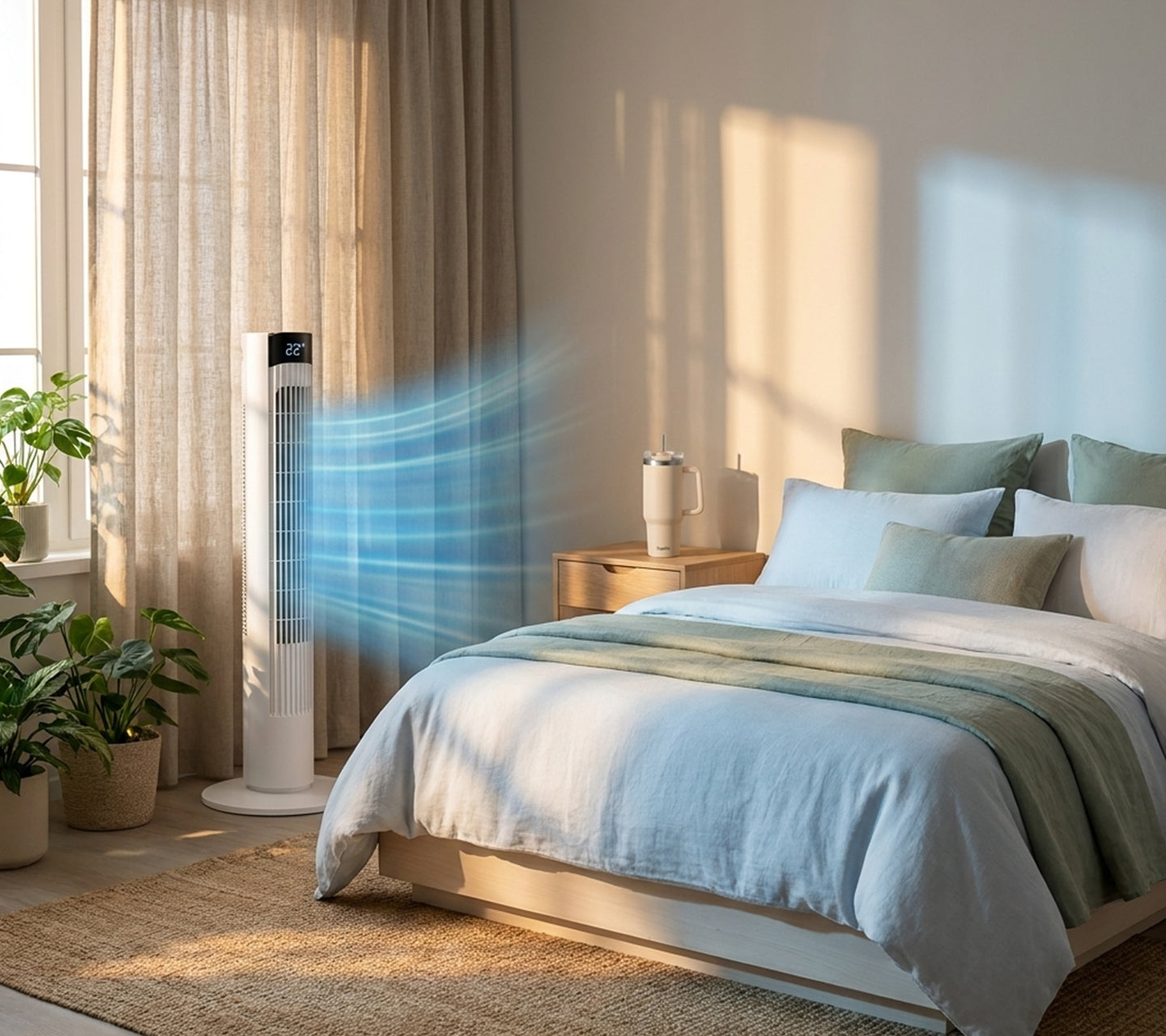
The Keplin 36-inch tower fan with remote control is a solid option for a bedroom. It’s tall enough to circulate air across the whole room, quiet enough not to keep you awake and comes with a sleep mode that varies airflow throughout the night for a natural effect.
If you need something more powerful, or you’re trying to cool a bigger room, the heavy-duty chrome floor fan gives you three speeds and serious airflow. It’s the kind of fan you point at an angle toward the ceiling so it circulates rather than blasting you directly.
Browse the full cooling range to compare models.
Rule 3: Put Ice in Front of the Fan - The Trick That Costs Almost Nothing

Here’s a genuinely useful trick that costs almost nothing. Place a tray or bowl of ice in front of your fan. As the air blows through, it picks up cold from the melting ice and the room temperature drops noticeably. It’s not a substitute for a real AC unit but on a hot night it can drop the perceived temperature by a couple of degrees. That’s enough.
Even better: use reusable freezer blocks instead of loose ice. The Keplin mini freezer blocks come in a pack of six, so you can rotate them. One set in front of the fan while the other is refreezing. They last longer than loose ice cubes and are considerably less messy to handle. Set this up on a low surface directly in front of your fan, at roughly the height the airflow exits. Give it ten minutes and you’ll feel the difference.
Rule 4: Fill Your Hot Water Bottle with Cold Water

A hot water bottle filled with cold water sounds like a joke but it’s one of the most effective sleep hacks going. The rubber holds the cold for longer than you’d expect, and a few minutes with it against your feet or the back of your knees (the spots where your body releases heat most efficiently) can make a real difference to how quickly you drift off.
Pop your Keplin faux fur hot water bottle in the fridge for twenty minutes before bed (not the freezer; you want cold, not painful). The cover means it’s comfortable to hold without going numb, and it stays cooler for longer than a bare rubber bottle would.
The same principle works for your pillowcase: stick it in the fridge in a bag for fifteen minutes before bed, then swap it just before you lie down. Those first ten minutes make a real difference.
Rule 5: Hydrate During the Day, Not Just at Bedtime

Your body uses water to regulate temperature through sweating. If you go to bed even mildly dehydrated, your core temperature stays higher for longer, which delays sleep onset. Even mild dehydration at bedtime disrupts your circadian rhythm and fragments your sleep. The fix isn’t to down a litre of water before bed (that just means a bathroom trip at 2am) but to sip steadily throughout the day so you’re properly hydrated by bedtime.
What you eat matters too. Heavy, fatty or spicy meals within two to three hours of bed raise your core temperature at exactly the wrong moment. A lighter dinner earlier in the evening removes one more obstacle between you and sleep.
Also think about keeping a 40oz Keplin vacuum-insulated tumbler on your bedside table.
It holds enough that you’re not refilling before you’ve fallen asleep, and the water stays cold until 3am when you actually need it.
Rule 6: Update Your Bedroom Setup for Summer

Beyond fans and ice tricks, small changes to your sleeping setup make a cumulative difference. Switch to a lighter summer tog duvet if you’re still using a winter one. Loose cotton or linen sleepwear tends to outperform synthetic fabrics at regulating temperature. They absorb moisture and let it evaporate rather than sticking to your skin.
If you want to make more changes to your sleep space, the Keplin bedroom comfort collection has options worth looking at, with accessories that are genuinely useful on hot nights rather than aspirational.
Rule 7: Keep the Heat Out Before It Gets In

This is one thing people overlook: if you spend the day outdoors in direct sun and then wonder why your bedroom feels like an oven by 9pm, that is the heat you have been soaking in. Shade the outside of your home during the day with a garden parasol, particularly on south-facing walls near your bedroom, to stop heat building up in the fabric of the house.
It’s also worth noting that calm evening time in a shaded outdoor space before bed, rather than sitting under artificial light indoors, can genuinely help your body start its wind-down process. If you’re making any changes to how you use outdoor space this summer, the Keplin garden and outdoors range has options for making that time more comfortable.
The Bottom Line: Two or Three Changes Is All It Takes

None of these solutions are too complicated. A few small changes like a decent fan in place, freezer blocks or lighter duvet on the bed mean you're not scrambling at midnight when the room won't cool down. The people who sleep well in summer aren't toughing it out - they've just sorted the basics in advance.
Pick two or three rules from this list that feel most relevant to your setup and start there. You don't need all seven. You just need enough of a difference to actually fall asleep.


