 Free Standard Shipping
 Pay Later with Klarna
 30-Day Easy Returns
 Good Housekeeping Award Winner




There is a particular kind of misery that comes from opening your cool bag at the beach to find the cheese has melted, the drinks are lukewarm and someone's forgotten the ice packs. Nobody wants that! A good cooler bag turns a decent day out into a great one - and a bad cooler bag is basically just a tote with ambition.
Whether you are packing for a full-day beach trip, a long weekend of barbecues or a spontaneous picnic in the park, the right bag makes all the difference. From compact everyday cool bags to insulated cool boxes that mean business, there is an option for every occasion. Here is a proper look at what to consider, what is worth buying and why.
What Makes a Good Cooler Bag?

Before you buy, it helps to know what you're looking for. Not all cool bags are created equal and the difference between a great one and a disappointing one usually comes down to a few key things. If you are shopping for one or two people on a half-day out, the Keplin 8.5L Cooler Bag is the compact starting point. For families and full-day trips, the rest of this guide covers everything you need.
Insulation thickness is a key point. Thicker foam walls hold the cold longer. For a full beach day in summer, you want something that can hold temperature for at least six to eight hours without needing constant topping up.
Capacity matters more than people expect. A 10-litre bag sounds reasonable until you try to fit drinks, lunch and snacks for two people in it. As a rough guide: up to 15 litres works for one or two people for a few hours. 20 to 30 litres suit a family or full-day outing. Anything above that? It's for serious camping or catering.
Waterproofing and lining keep things practical. Leak-proof linings mean that when your frozen bottle of water starts to thaw (and it will!), everything else stays dry. Outer fabric that handles sand, grass and the occasional grass stain is a bonus.
Portability depends on how far you're carrying it. Padded shoulder straps are worth every penny once you're walking to a beach three car parks away.
Cooler Bags: What to Look for and What to Buy
For most days out (beach trips, park picnics, garden BBQs), a soft-sided cooler bag is the right accessory. They're lightweight, easy to carry and good enough to keep things cold for a full day when paired with decent ice packs.
The main thing to get right is size. Too small and you're rationing drinks before midday, which nobody wants. If you go too large, you'll be lugging dead weight for nothing. For a family or a group, something in the 25 to 30 litre range tends to hit the sweet spot. It's enough room for food, drinks and ice packs without the bag becoming the main event.
Beyond capacity, look for reinforced stitching, a proper zip closure and a waterproof lining that won't soak through if an ice pack shifts. Padded shoulder straps are worth seeking out too, especially if the bag is going any distance from the car.
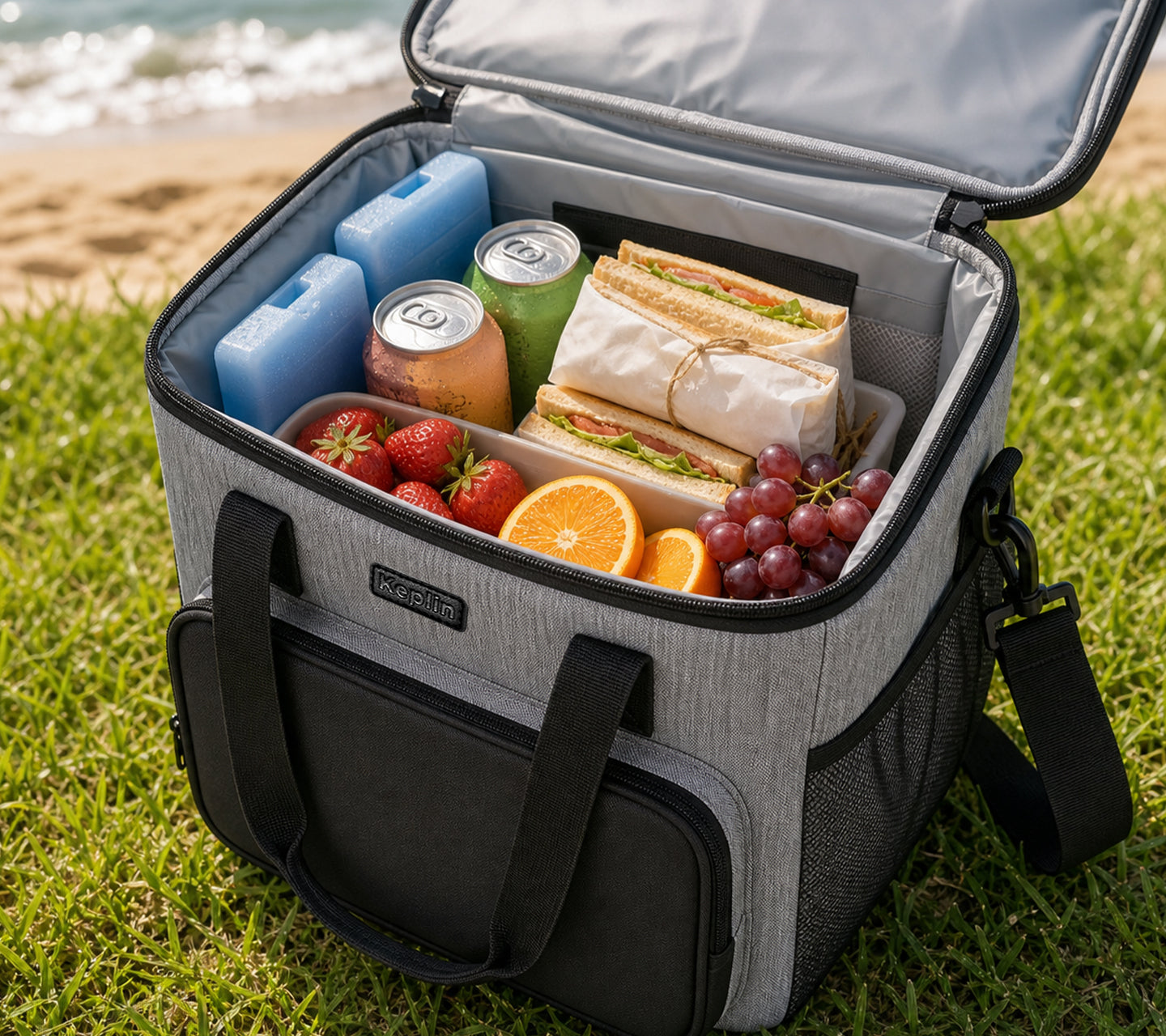
The perfect middle-ground: The Keplin 27L cooler bag ticks all of these. It handles a family's worth of food and drink without needing Tetris-level packing skills! The waterproof lining keeps things clean when the ice packs start to melt, and the padded shoulder strap earns its keep on the walk from the car park. One customer summed it up well: "Great item. Really spacious and did everything I needed it to do." - Verified Keplin buyer.
Ice Packs: The Thing People Always Forget
You can have the best cooler bag in the world and still open it four hours later to warm drinks. Why? Because one flimsy ice pack from the back of the freezer is not doing the job. Ice packs are where people chronically under-invest.
Multiple smaller ice packs outperform a single large block every time. They distribute the cold more evenly and let you layer them around the food rather than just dumping one on top and hoping for the best. As a rule of thumb, use at least two packs for every six to eight hours you need the bag to stay cold.

The fix: The Keplin reusable mini freezer blocks come as a set of six, which is exactly what you need. They freeze quickly, last well and come in multiple colours - a small detail, but genuinely useful when you're trying to work out which ones are still cold mid-picnic. In a well-insulated bag, six packs will keep things cold from morning to late afternoon without any topping up.
Cool Boxes vs Cool Bags: When You Need to Upgrade
A cool box is a different proposition to a cool bag, and it's worth understanding the distinction before you buy. Cool boxes are rigid, more heavily insulated and built for situations where cold storage needs to last. They're perfect for multi-day camping trips, fishing days or boot storage on a long drive. They hold temperature longer and take more of a beating, but they're heavier and not designed to be carried far.
If you're heading out for a day trip and want something to sling over your shoulder, a cool bag is the better call. But if you're packing for a weekend away, loading a campervan or need something that can survive being sat on, a cool box earns its keep.
Look for a tight-sealing lid, sturdy carry handles and insulation thick enough to cope with repeated opening and closing throughout the day. Size-wise, 20 to 25 litres is enough for most camping or fishing scenarios; big enough to be useful, small enough not to dominate the boot.

The right call: Get the Keplin 24L insulated cool box, which is built for exactly this. The rigid shell protects the contents properly when packed alongside camping gear, the insulation holds cold for extended periods, and the carry handles are solid enough to manage fully loaded. Have a look at the full camping collection for everything else you might need alongside it!
Which Keplin Cooler Is Right for Your Summer Plans?
A decent cooler bag is one of those purchases that pays for itself the first time you open it at the beach and everything is exactly as cold as it should be. Get the size right for your group, use enough ice packs and pick insulation that matches how long you need the cold to last.
The 27L cooler bag is the everyday workhorse for most people. The 24L cool box is the upgrade when you need it to work harder. If you're heading into full camping territory, the camping collection has everything to go with it. And the reusable ice packs are non-negotiable regardless of which bag you choose.
Check out the full cooling and picnic collection to find the right combination for your summer plans.


